
· Maya Colton
Toe spacers and plantar fasciitis: what the evidence supports
Plantar fasciitis is the second question I get after bunions. Heel pain is a different animal from crowded toes: the sore tissue runs under the arch, not between the toes, and the published studies on toe spacers were done on other feet. So this guide separates what has been measured about heel pain from what has been measured about spacers, and names the one slot a spacer fills. I sell the product, so every claim below carries its paper.
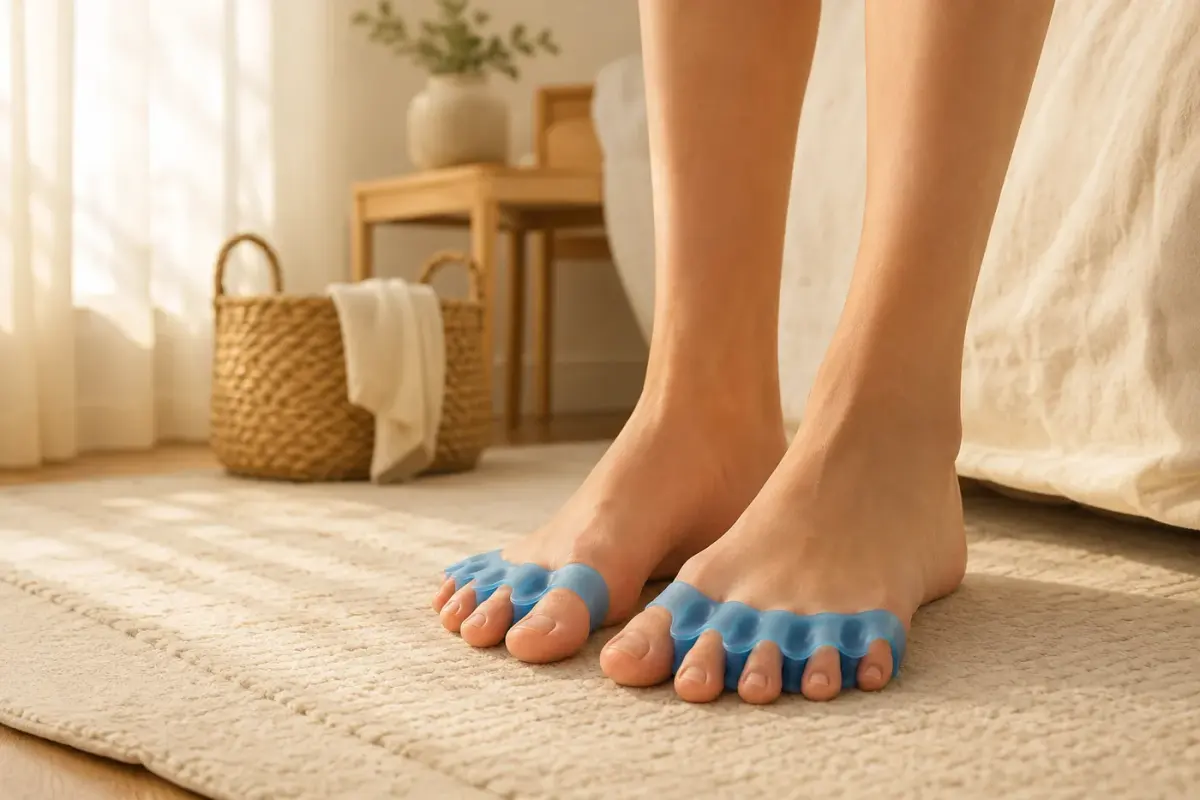
What plantar fasciitis is, and where the toes come into it
The plantar fascia is, in the words of the American Academy of Orthopaedic Surgeons' patient site OrthoInfo, "a long, thin ligament that lies directly beneath the skin on the bottom of your foot". Plantar fasciitis is the irritation of that band near the heel, and OrthoInfo counts roughly 2 million patients treated for it every year. The signature symptom is pain under the heel with the first few steps out of bed or after a long rest, easing after a few minutes of walking.
Here is where the toes enter. The fascia is anchored at the base of each toe, so when the toes are pulled up toward the shin the band tightens and lifts the arch. Bolgla and Malone (Journal of Athletic Training, 2004) describe it as a cable strung between the heel bone and the toe joints: dorsiflexion "winds the plantar fascia around the head of the metatarsal". Clinicians call it the windlass mechanism, and it is why the plantar fascia stretch below is done by pulling on the toes, not the heel. A toe spacer does not pull the toes up; it holds them apart, side to side.
What the evidence supports for heel pain itself
The risk-factor study most often cited is Riddle and colleagues' matched case-control study in the Journal of Bone and Joint Surgery (2003): fifty patients with plantar fasciitis, two matched controls each. People whose ankle would not bend past neutral with the knee straight had an odds ratio of 23.3 against those with more than ten degrees of movement; a body-mass index above 30 carried 5.6, and spending most of the workday on your feet 3.6. The authors call reduced ankle dorsiflexion the most important risk factor; OrthoInfo's list of causes adds tight calves, new or increased activity, repetitive impact, long standing on hard surfaces, flat feet or a high arch, and age between 40 and 60.
odds ratio of plantar fasciitis when the ankle bends to 0° or less with the knee straight, against more than 10° (BMI over 30: 5.6; most of the workday on your feet: 3.6)
— Riddle et al., J Bone Joint Surg Am, 2003
OrthoInfo's simple measures include rest, ice, the calf stretch, the plantar fascia stretch, night splints, and supportive shoes or inserts; the NHS adds what to avoid: high heels, tight pointy shoes, backless slippers, and walking barefoot on hard surfaces. More than 90% of patients improve within 10 months of starting those simple measures, by OrthoInfo's count. The one that involves your toes directly is the plantar fascia stretch: DiGiovanni's randomized trial (Journal of Bone and Joint Surgery, 2003) put 101 patients with heel pain of at least ten months on either calf stretching or a non-weight-bearing program of pulling the toes back, for eight weeks, and the toe-pulling group did better on worst pain and on first-step morning pain.
What the evidence says about toe spacers and plantar fasciitis
Very little. The only systematic review of toe separators as a physiotherapy tool, by Krześniak and Truszczyńska-Baszak in the Journal of Clinical Medicine (December 2024), screened 1,020 records and kept ten. Those ten cover hallux valgus, skin and nail problems, the curled toes of stroke patients, and muscle activity while walking. Plantar fasciitis appears in the review's inclusion criteria and in none of its results: not one of the ten studies tested a separator on a heel. The reviewers add that in most of the included papers the methodological quality was not reported, as we noted in what toe spacers actually do.
The registries are no fuller. A recent registered trial of consumer toe separators, a Spanish pilot completed in May 2025 (NCT07004543), measured plantar pressure and comfort in 32 adults with no foot complaint, over a single session. And a primary-care review of over-the-counter foot remedies (Bedinghaus and Niedfeldt, American Family Physician, 2001) calls stretching of the plantar fascia and Achilles tendon the mainstay of treatment, and does not mention a toe separator at all. No product page can cite a trial for heel pain; ours does not try.
studies in the only systematic review of toe separators that tested them on plantar fasciitis (1,020 records screened)
— Krześniak & Truszczyńska-Baszak, J Clin Med, 2024
The small muscles of the foot, and why the toes still matter
Allen and Gross (Journal of Orthopaedic and Sports Physical Therapy, 2003) tested toe flexor strength in 20 people with plantar fasciitis on one side and 20 matched controls: the fasciitis group had weaker toe flexors, and their sore foot was weaker than their own other foot. Cheung and colleagues (Journal of Science and Medicine in Sport, 2016) scanned the feet of 20 experienced runners, half with chronic plantar fasciitis in both feet, and found smaller muscle volume in the rear of the foot in the fasciitis group. Whether weak muscles cause the pain or result from it is open, and Allen and Gross say so. McKeon's "foot core" paper (British Journal of Sports Medicine, 2015) adds that clinicians largely ignore these muscles.
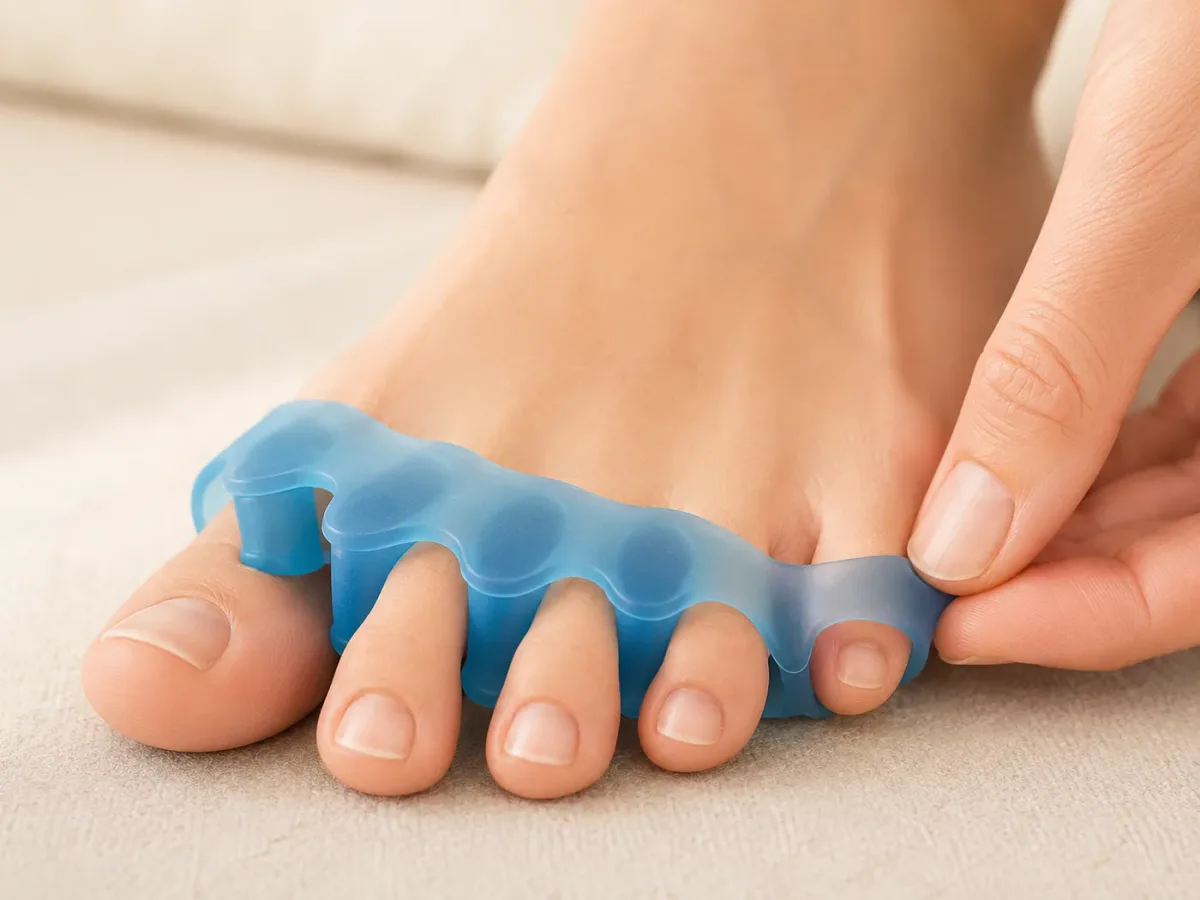
A randomized trial from the University of Virginia (Clinical Biomechanics, 2026) put 34 people with plantar fasciopathy through eight weeks of foot exercises, with or without minimalist shoes: strength of the big toe and the lesser toes rose significantly in both groups. Training the toes is a legitimate part of a heel-pain plan, prescribed by a clinician. A spacer's part in that plan is specific: it gives each toe its own room, so that when you practise splaying or pressing the toes, each one moves on its own.
Where a spacer fits in a plantar fasciitis routine
Most heel-pain self-care happens sitting down, barefoot, a few minutes at a time: the toe-pull stretch that OrthoInfo says is best done in the morning before standing or walking, the ice, the toe exercises. The gel pair is built for that position. At 1.5 cm thick it is a seated, barefoot tool that spaces all four gaps at once while the foot rests. The routine: spacers on while you sit on the edge of the bed, toe-pull stretch with the spacers still in, spacers off, calf stretch at the wall, and the same sequence in the evening once the shoes come off. Runners in my groups run it as the cool-down on our toe spacers for running page. The stretch does the fascia work; the spacer gives each toe room to move while it happens.
Wear it seated: the NHS advice with plantar fasciitis is to avoid walking barefoot on hard surfaces, and the gel pair is worn barefoot, so the session happens on the bed, the couch or the mat, and the spacers come off before you stand up.
How to run a session while the heel is sore
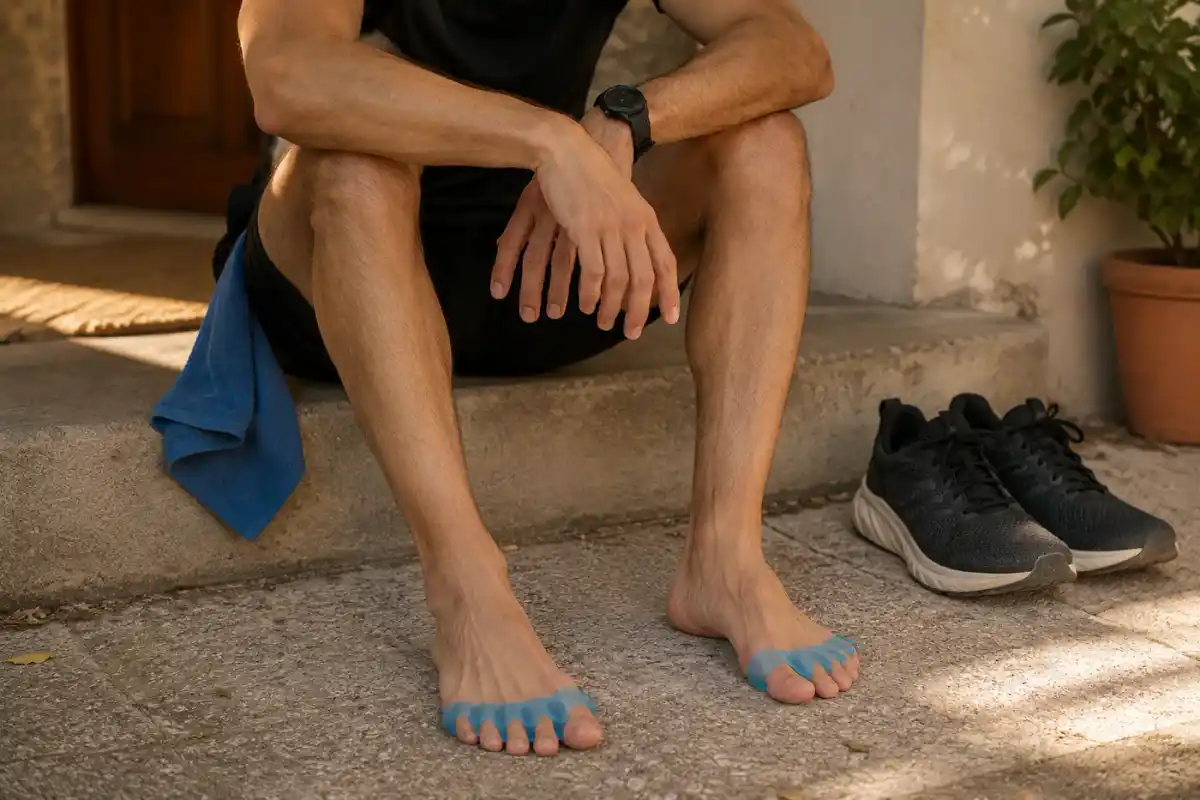
Stricter than my usual wear-time schedule, because the foot is already irritated. Sit, shoes and socks off, spacers on before the first steps of the day. Fifteen minutes is the whole first session, and the toe-pull stretch happens inside it: cross the sore foot over the other knee, take hold of the toes, draw them back toward you, hold for ten seconds, and repeat, which is OrthoInfo's protocol at 20 repetitions per foot. Spacers off, then the wall calf stretch. Judge the heel an hour later, on the first steps after the session. Build toward 30 minutes over two weeks only if the heel is not louder the next morning.
Stop signals, with one addition. Numbness, tingling, or burning between the toes means the spacers come off. Heel pain that is worse the morning after a session means the session was too long. And heel pain that has not improved after two weeks of self-care is the NHS threshold for seeing a doctor; severe or worsening pain, tingling or loss of feeling, or diabetes moves that appointment forward.
randomized trial: eight weeks of the toe-pull plantar fascia stretch beat calf stretching on worst pain and first-step morning pain in chronic heel pain
— DiGiovanni et al., J Bone Joint Surg Am, 2003
Which of our two products suits this foot
The soft gel five-toe pair, at $19.95. Molded in SEBS gel, 8.5 x 3 x 1.5 cm in one stretchy size, it spaces all four gaps at once while you sit. Its softness matters for a foot that is already sore, and 187 verified buyers rate it 4.6 out of 5. The targeted separator tubes do a different job, holding one gap open inside a shoe for a bunion or an overlapping toe; for the seated routine on this page, the gel pair is the one. One verified buyer wrote: "Highly recommended. It's the softest and most flexible spacer among the ones I've tried." Orders ship free, arrive in 6 to 10 business days, and carry a 30-day money-back guarantee.
The bottom line
Plantar fasciitis is a heel and arch problem, and the measures with published support act on the calf, the fascia and the shoes. No trial has tested a toe spacer on it, and this page has not claimed one. What a spacer does is hold your toes apart, gently, for the length of the seated session in which the stretches and toe exercises happen anyway; the gel pair is the soft end of our range and the right one for that session. Get the diagnosis first, keep the two-week threshold, and if you are under care, ask your clinician where a spacer fits. More in how we test and in the guide to Morton's neuroma.
ToeRoom sells comfort products and holds no medical qualification. Nothing here is a diagnosis or a treatment plan. For heel pain that lasts more than two weeks, or any numbness, see a podiatrist.
Plantar fasciitis and spacer questions, answered
Can toe spacers cure plantar fasciitis?
No. A toe spacer is a comfort product, not a treatment, and no published trial has tested one on plantar fasciitis. Plantar fasciitis is diagnosed and managed by a clinician; the home measures with published support are calf stretching, the toe-pull plantar fascia stretch, supportive footwear, and foot-muscle exercises.
Should I wear toe spacers while my heel is flaring up?
Sit down for the session. The NHS advises against walking barefoot on hard surfaces with plantar fasciitis, and our gel pair is a barefoot tool, so use the seated slot: on the edge of the bed before your first steps. Fifteen minutes to start, off at the first sign of numbness or tingling.
Gel five-toe pair or separator tubes for a foot with heel pain?
The gel pair. It spaces all four gaps at once during a seated barefoot session, which is where a spacer sits in a heel-pain routine. The tubes are built for one gap inside a shoe, a bunion or an overlapping toe. Neither product is a treatment for the fascia.
When should I see a podiatrist about heel pain?
The NHS threshold is two weeks: if the pain has not improved after two weeks of self-care, see a doctor. See one sooner if the pain is severe or getting worse, if there is tingling or loss of feeling, or if you have diabetes.

Maya Colton · Foot Wellness and Barefoot Movement Coach
Trail runner and certified movement coach. I have worn toe spacers through 5 years of marathon training blocks, yoga teacher trainings, and long days in narrow shoes.